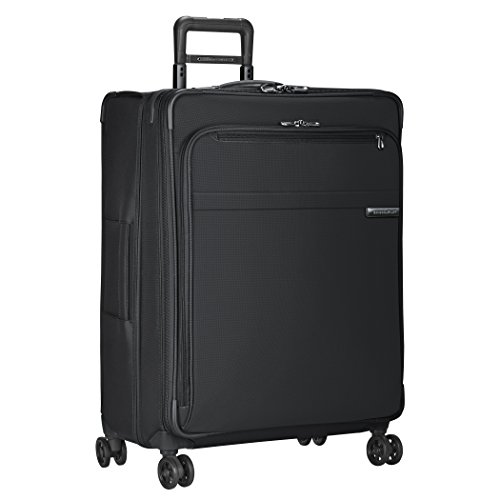
Some carry-ons are bought for their looks. The Briggs & Riley Baseline Essential 22 is bought for a different reason: the maker’s promise that it will repair the bag if it breaks, for life, even when the damage was done by an airline. If you fly domestically every few weeks and your luggage keeps coming back from the belt or the gate-check cart with a broken wheel or a ripped corner, that promise is the whole point. The price of entry is weight. At 10 lbs empty, according to Briggs & Riley, it is the heaviest bag we cover on this site. This profile goes through what the maker says about it, how the size works against the 22 x 14 x 9 in limit that major US airlines publish, and who should look elsewhere. For the full ranking, see our best carry-on luggage of 2026 comparison.
We do not run our own travel trials. Everything here comes from the Briggs & Riley product page, and where we mention airline limits we attribute them to the source that states them.
The Short Version
Briggs & Riley describes the Baseline Essential 22” Carry-On Spinner as “the ultimate domestic carry-on.” It is a softside bag made from what the company calls premium ultra-durable ballistic nylon, with four spinner wheels, impact-resistant corner guards and self-repairing YKK zippers. Its signature feature is CX Smart Packing Technology: the bag expands for more room, then compresses back down so it fits most US overhead bins.
The trade-offs are plain. It weighs 10 lbs empty. Its dimensions sit exactly on the 22 x 14 x 9 in line that American, Delta and United publish. And it belongs to the premium tier of this site, as the price-range badge on this page shows. For a traveler who values warranty coverage above all, those are acceptable costs. For a traveler who wants the lightest possible bag, they are not.
Specs According to Briggs & Riley
All figures below come from the Briggs & Riley product page.
- Exterior dimensions: 22 x 14 x 9 to 11.5 in (55.9 x 35.6 x 22.9 to 29.2 cm). The depth range is the key detail: 9 in compressed, 11.5 in expanded.
- Case dimensions: 20 x 14 x 7.95 in (50.8 x 35.5 x 20 cm).
- Weight: 10 lbs (4.6 kg).
- Capacity: 2,240 to 2,940 cubic inches, or 37 to 48 liters.
- Material: premium ultra-durable ballistic nylon.
- Wheels: 360-degree spinner wheels, which the company describes as smooth and silent.
- Zippers: self-repairing YKK zippers.
- Guarantee: lifetime guarantee that covers damage even by an airline (read the full terms on the maker’s guarantee page).
The page lists these as exterior measurements. When you compare any bag with an airline’s limit, remember that airline limits usually include wheels and handles, so confirm with the maker or a sizer before you assume anything.
How the CX Packing System Works
Briggs & Riley says its patented CX Smart Packing Technology “expands to give you up to 30% more space, then compresses back to carry-on size.” In practice that means the bag has two jobs. When you are packing on a longer trip, you open the expansion and use the larger 48-liter volume. When you head to the airport, you compress the bag back to its 9 in depth so it meets the carry-on limit, and the compression system keeps the load tight rather than bulging.
The honest reading is this: the compressed bag is the carry-on, and the expanded bag is a bag you would check. The 11.5 in expanded depth is more than two inches over the 9 in depth limit that major US airlines list. Briggs & Riley’s own wording is careful on this point, saying it “compresses for an easy fit in most US overhead bins.” It does not say every bin, and we will not either.
The exterior-mounted Outsider handle is the other signature piece. On many roller bags, the telescoping handle rails run through the interior and leave a raised ridge at the bottom of the packing area. Briggs & Riley mounts its handle on the outside, which the company says creates a flat, ridgeless interior that simplifies packing. The page also lists premium cinch-down garment panels that hold clothes in place and keep wrinkles to a minimum.
Size and Weight, Honestly
This is where the Baseline Essential 22 asks for compromise.
Size. The listed exterior of 22 x 14 x 9 in matches the limit that American, Delta and United publish, according to Travelpro’s carry-on size page. Matching a limit is not the same as clearing it. If a gate agent places a sizer next to the bag and the wheels or handle add even a fraction of an inch, you may be asked to gate-check. Southwest lists a larger 24 x 16 x 10 in limit, according to the same Travelpro page, which makes it a more comfortable airline for this bag. Regional jets have smaller bins, and Travelpro’s page tells travelers to expect a gate-check on those flights regardless of brand. That applies to every carry-on we cover.
Weight. Ten pounds is a lot of luggage before a single sock goes in. The bag still has to be lifted into an overhead bin, often by one person, often at the end of a long travel day. If you have a shoulder injury, travel with a heavy laptop bag on top, or simply pack heavy, the weight difference between this and a lighter bag is something you will feel on every trip. Our Travelpro Platinum Elite 21 profile covers a lighter softside alternative at 7.8 lbs according to Travelpro, with a similar expandable design.
Warranty and Airline Damage
The guarantee is the strongest argument for this bag. Briggs & Riley describes its lifetime guarantee this way: if your bag is damaged, even by an airline, the company will repair it for life, free of charge, with no proof of purchase needed. The company calls it “the best guarantee in travel.”
Two practical cautions. First, a guarantee is only as useful as the repair process behind it, and we cannot evaluate how fast or convenient repairs are. The brand’s site lists repair options and a repair-status page, which you should read before buying. Second, because you may buy through a retailer rather than directly from the brand, check the terms for your specific purchase and confirm the seller is authorized. The page we read does not spell out how a retailer purchase is handled, so we leave that question open.
Who It Is For
- Frequent domestic flyers who put a bag through dozens of gate checks and bin loads a year and want repair coverage that lasts as long as the bag.
- Business travelers who carry suits, because the flat interior and cinch-down garment panels are designed around wrinkle control.
- Packers who need the occasional extra room and are disciplined enough to compress the bag for the airport.
Who Should Skip It
- Anyone who wants the lightest bag. At 10 lbs, this is the heaviest of our eight picks. Our Victorinox Spectra 3.0 Frequent Flyer profile describes a hardside bag that Victorinox lists at 3.3 kg (about 7.3 lb).
- Travelers who fly strict airlines with no margin for error. A bag that sits exactly on the size limit has no slack if your airline measures with wheels and handles.
- Casual flyers who take two trips a year. The lifetime guarantee is worth the most to people who use the bag hard.
- Anyone who prefers a hard shell. This is a softside bag, with the give and the abrasion profile that implies.
Pros and Cons in Detail
What stands out
- A lifetime guarantee that Briggs & Riley says covers airline damage with no proof of purchase.
- A compression and expansion system that gives 37 to 48 liters of range.
- A flat interior thanks to the exterior-mounted Outsider handle.
- Self-repairing YKK zippers and corner guards, per the maker.
What to weigh
- 10 lbs empty.
- Exterior size at, not under, the 22 x 14 x 9 in limit.
- Expanded depth of 11.5 in means it must be checked when expanded.
- Premium-tier positioning.
Bottom Line
The Baseline Essential 22 is a bag for people who think about luggage as a long-term tool. Its best features are about durability and repairability, and its worst are about weight and size margin. If you fly often and want one bag to last for years, it is the most carefully documented choice in this group. If you fly occasionally or want to move through the airport lightly, one of the lighter bags will serve you better. Our full comparison of the best carry-on luggage for 2026 puts all eight bags side by side.
Sources